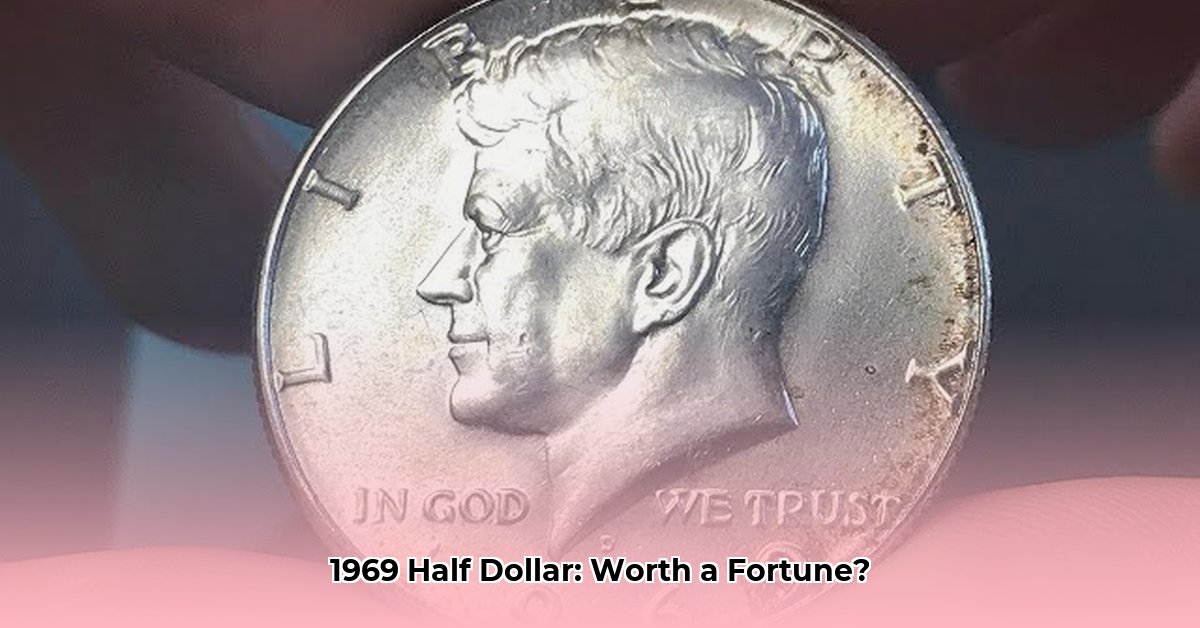
Ever wonder about the true worth of that 1969 Kennedy half-dollar tucked away in your collection? Its value isn't simply tied to its year of minting; a myriad of factors influence its price. For more information on valuing older half dollars, check out this helpful resource on 1912 Half Dollar Values. This guide provides a comprehensive approach to determining its potential value, covering key aspects from grading to investment strategies.
Key Factors Affecting the Value of Your 1969 Half Dollar
Several critical elements determine the value of a 1969 Kennedy half dollar. Understanding these factors allows for a more accurate assessment of your coin’s worth.
1. Mint Mark: Location, Location, Location
The small letter – "D" for Denver or "S" for San Francisco – located near the date reveals the coin's origin. Coins from the San Francisco mint ("S") are generally more valuable due to their lower mintage compared to those from Denver ("D"). Did you know that a 1969-S Kennedy half-dollar, in pristine condition, can fetch significantly higher prices than its Denver counterpart?
2. Condition: The Sheldon Scale and Your Coin's Grade
Coin condition drastically impacts value. Numismatists use the Sheldon grading scale (1 to 70) to objectively assess a coin's wear and tear. A higher grade indicates a coin in better condition, commanding a higher price. An uncirculated coin (showing minimal wear) will always be worth more than a circulated coin with noticeable scratches and blemishes. Visual guides comparing different grades are readily available online.
3. Silver Content: Weighting the Value
1969 Kennedy half-dollars boast 40% silver content. Fluctuations in the silver market directly influence the coin's value. As silver prices rise, so too does your coin’s worth. Currently, the silver market is experiencing [insert current market trend and source here]. This fact alone speaks volumes to any investor. Is this factor influencing your investment decisions?
4. Error Varieties: Rarity Increases Value
Minting errors, such as mis-struck dates, off-center designs, or other anomalies, can significantly increase a coin's value. These errors, often subtle, make each coin unique. Do you possess a 1969 half dollar containing a minting error? Could it be rare and valuable?
5. Proof vs. Uncirculated: A Difference of Finish
Proof coins are specially minted for collectors, showcasing a mirror-like finish, unlike regular uncirculated coins. This superior quality and limited production often mean significantly higher value. Did you know that proof coins from the San Francisco mint ("S") are among the most collectable varieties?
Determining the Value: Steps to Accurate Assessment
Now, let’s explore how to accurately determine the value of your 1969 Kennedy half-dollar. Remember, combining several methods increases your accuracy.
Step 1: Professional Grading (Essential for Accurate Valuation): Professional grading services provide objective assessments, using established standards. This removes subjectivity and establishes a coin's market value.
Step 2: Online Resources and Databases (A Quick but Incomplete Overview): Use online databases to research comparable coins and establish a preliminary price range. However, this offers an incomplete picture.
Step 3: Auction Results (A Glimpse into Current Market Trends): Analyze auction data to understand current market prices for similar coins. This offers a real-world valuation.
Step 4: Reputable Coin Dealers (Experienced Opinions): Consulting a knowledgeable dealer provides invaluable insights into your coin's condition and market value. Their expertise offers critical context.
Investment Considerations: Strategies and Risks
Investing in 1969 Kennedy half dollars presents both opportunities and risks. Planning carefully is key to success.
Short-Term Strategies: Focus on buying undervalued coins and selling them quickly at a higher price. This strategy requires actively tracking market fluctuations.
Long-Term Strategies: Acquire high-grade or error coins and hold them for appreciation over time. This is a more passive approach.
Risk Assessment: Price volatility in the silver market and grading subjectivity are inherent risks. Buying from reputable sources and obtaining professional grading mitigate some of these risks.
Conclusion: Putting it All Together
The value of your 1969 Kennedy half-dollar depends on various factors: mint mark, condition, silver content, potential errors, and whether it’s a proof or uncirculated coin. A comprehensive approach using professional grading, online research, auction data, and consultation with reputable dealers is essential for determining its true market value. Remember to carefully weigh your investment strategy against the inherent risks involved.